> ## Documentation Index
> Fetch the complete documentation index at: https://www.latentcast.com/docs/llms.txt
> Use this file to discover all available pages before exploring further.
# The parts of a story
> Scenes, narration, the presenter, backgrounds and on-screen events — what you are looking at when the preview plays.
A story is assembled from a few kinds of part. You do not have to know them to watch a preview, but
you do need them to ask for a change, because they are the words the product and the
[tuning chat](/docs/guides/stories/tuning-chat) use.
## Scenes
A story is divided into scenes, usually a handful, depending on length. Each
has its own script and its own visuals. Scenes carry a role: one opens the story, one closes it, and
the rest carry the topics in between. The opening stays first and the closing stays last, whatever
else you reorder.
## Narration
The narration is a scene's script, and the audio is that script spoken
by the presenter's voice. The system writes to a length that fits the duration you asked for.
Narration is the part with consequences. Change the words, and the audio is re-spoken, the on-screen
text is re-timed to the new words, and the scene's length moves. That is handled for you, but it is
why a wording tweak takes longer than moving a logo.
## The presenter
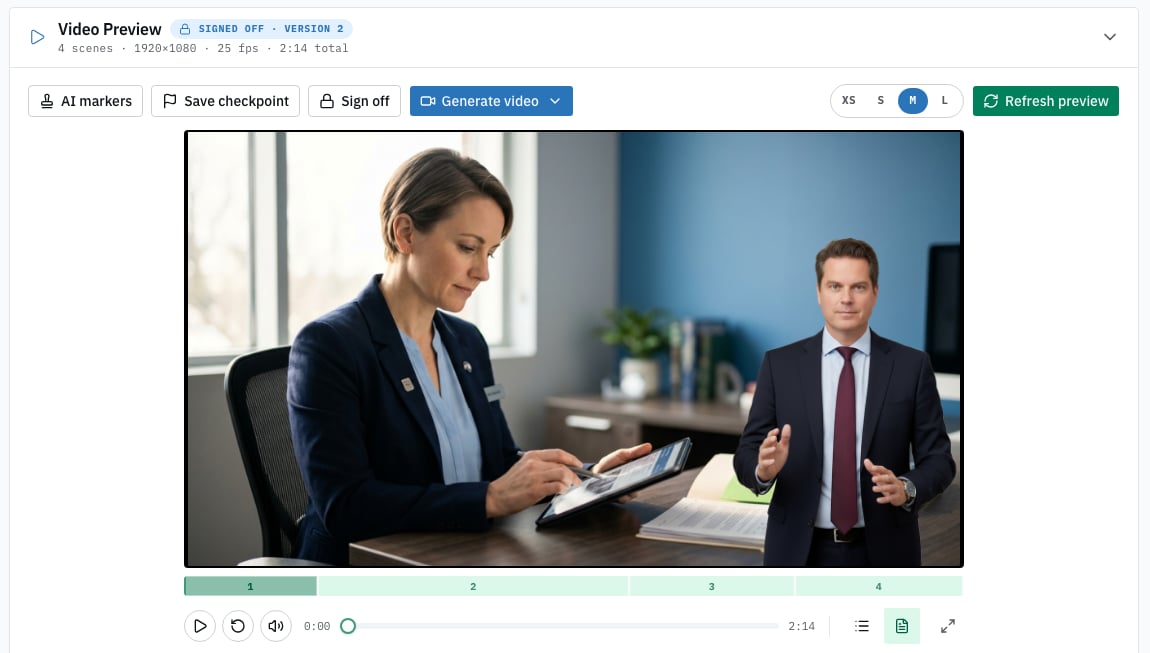
Your colleague on screen: their avatar, speaking with their
voice. A scene shows them one of two ways.
* **As a still image.** A single frame of the presenter over the background. This is how a story is
built by default, because it is fast and cheap while you are shaping the content.
* **As a moving video.** The presenter animated and lip-synced to the narration. This is the
expensive step, so you take it once you are happy with everything else.
You can also set where the presenter stands, how large they are, and whether they appear at all,
scene by scene.
**Re-recording a scene's audio returns its presenter to a still image.** If you change the narration
or the voice for a scene that had an animated presenter, the animation no longer matches the words,
so it is set aside and the scene falls back to the still. Re-animate it when the script is final.
Doing the script work first and the animation last avoids paying for it twice.
## Backgrounds
Behind the presenter sits a background: a photograph, a generated
image, or a short video clip, chosen to match what the scene is about. Backgrounds can be layered,
can move slowly across a still image, and can fade from one to the next.
A **flow** is a special case: a sequence of backgrounds that walks through something step by step.
When your material describes a process, the system lays it out as a flow so the progression reads
on screen.
## On-screen events
On-screen events are the graphics that appear at a chosen moment, timed to
land on the words they belong to. There are four:
| Event | What it is |
| ------------------ | --------------------------------------------------- |
| **Title** | A headline or section title |
| **Text highlight** | A key phrase emphasised as it is spoken |
| **Data point** | A figure called out, such as "+216%" |
| **Logo** | A company or product logo shown at the right moment |
## The preview
The preview plays all of it together. It is where you do your reviewing, and it is drawn live from
the story, so it reflects every change within seconds of you making it.
 ## Next
Change any of this by asking for it.
Watch it properly, then make the video.
## Next
Change any of this by asking for it.
Watch it properly, then make the video.